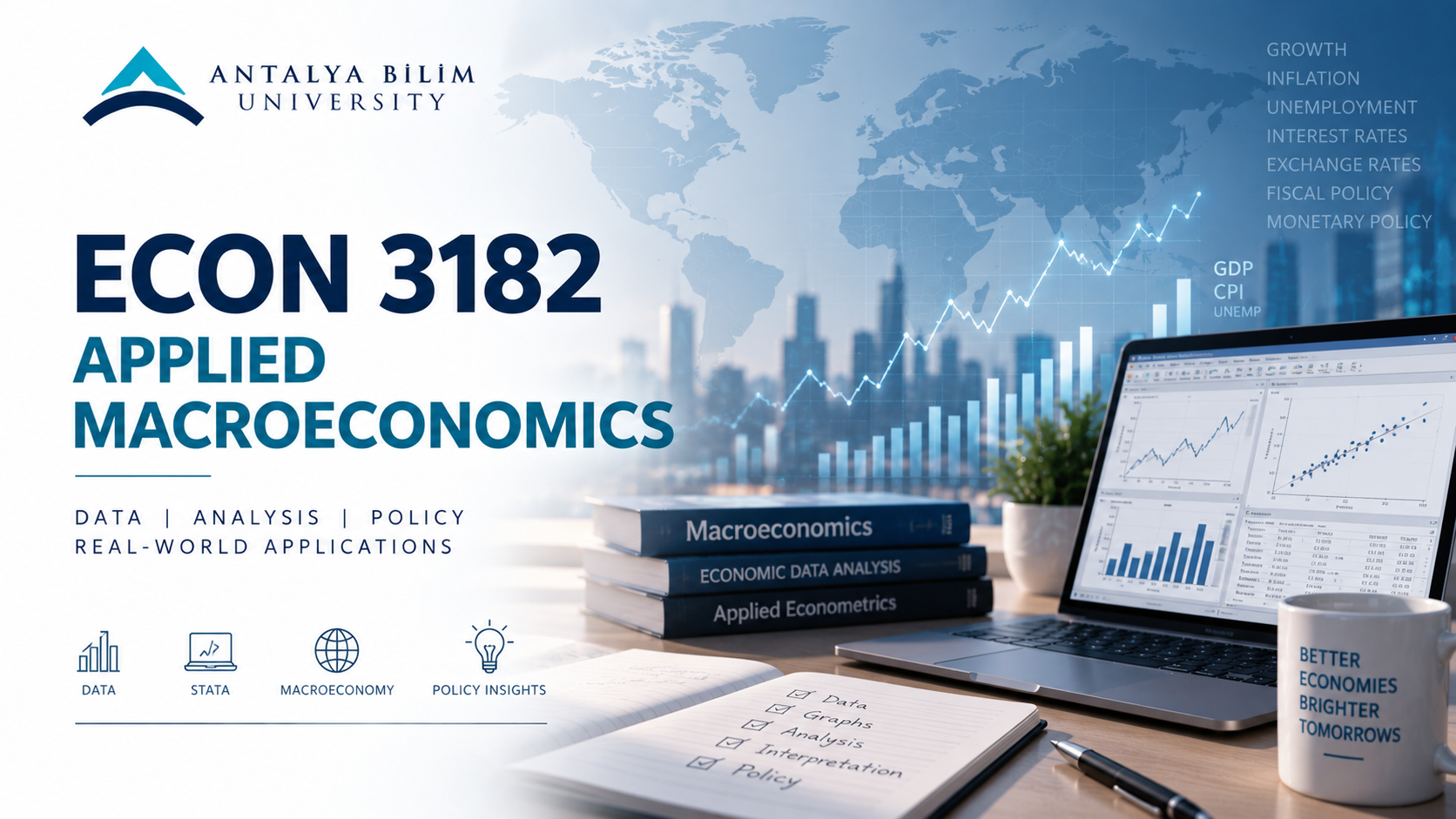
Welcome to Applied Macroeconomics. This course focuses on the practical use of macroeconomic concepts and data to understand real-world economic developments. Rather than emphasizing advanced mathematical models or econometric techniques, the course develops students' ability to read macroeconomic indicators, visualize data, identify basic empirical relationships, and interpret economic policy issues.
The course begins with an introduction to macroeconomic data and basic use of STATA. Students will work with familiar indicators such as gross domestic product (GDP), economic growth, inflation, unemployment, interest rates, exchange rates, government expenditure, public debt, exports and imports. Selected data from Türkiye and international sources will be used throughout the semester.
During the first half of the semester, applications will concentrate on economic growth, inflation and labor-market developments. Students will use tables, line graphs and scatter plots to examine macroeconomic patterns and simple relationships such as Okun's Law and the Phillips Curve. The emphasis will be on economic interpretation rather than technical estimation.
After the midterm examination, students will be introduced to simple linear regression as a practical tool for macroeconomic analysis. Applications will include the consumption-income relationship, monetary policy and inflation, fiscal indicators, and open-economy variables. Students will learn how to interpret the sign and magnitude of a coefficient, statistical significance and R-squared without moving into advanced time-series econometrics.
Laboratory sessions are integrated into the course. STATA will be used for importing data, generating descriptive statistics and growth rates, producing basic graphs, calculating correlations and estimating simple regressions. Students will not be expected to memorize long command sequences; the central objective is to understand what the data and statistical output mean economically.
By the end of the course, students should be able to identify and interpret major macroeconomic indicators, use basic STATA commands to explore macroeconomic data, produce and discuss simple graphs and regressions, and connect empirical patterns with core macroeconomic concepts and policy questions.
- Öğretmen: Kemal ERKİŞİ